Bruce Hayes - Personal


Personal History

I was born in Seattle, WA in 1955. My first childhood home was graduate student housing at the University of Washington, where my father was completing a Ph.D. in Social Psychology.

In my childhood the United States was a stunningly prosperous country. It hard for us now to imagine the wondrous events of this time. A dread disease, polio, was conquered by a vaccine administered to all. The California State Legislature added six new campuses to the state's university and made it possible to attend the university without paying tuition. At UCLA, funding levels made it possible to establish a new Linguistics Department (1966), which achieved a high national ranking after existing for just a couple years. In Seattle, where I was living, the World's Fair of 1962 reflected the sense of prestige and hope then attached to science and technology. Of course, all sorts of horrible problems were lurking immediately beneath the surface (racial persecution, suppression of women, environmental destruction, the premonitions of the Vietnam War), but the surface optimism was palpable.

The image shows the Space Needle, built for the fair, which still graces the Seattle skyline. My family was not as glamorous as the one in the advertisement but was more numerous: my four siblings, all sisters, were born 1954, 1956, 1961, and 1962.
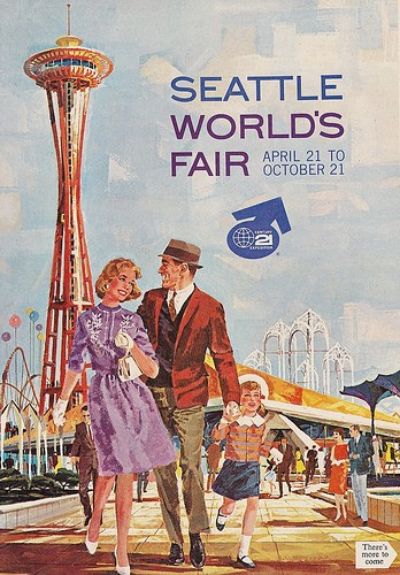
Family at the 1962 Seattle World's Fair

My family moved around a number of times as my father pursued a career, but in 1963 settled down in Ithaca, N.Y, where my Dad was for many years a professor in the Sociology Department at Cornell University. Although I wasn't born there, I think of myself as an Ithacan.

I grew up without the Internet and my childhood interests were concrete: a erector set, a microscope, slot cars, salamanders under rocks, stilts; later on science reading such as Isaac Asimov and Scientific American magazine. I also joined a curious trend of the time and built a harpsichord from a kit.

I did like computers, however. At the time they were few, expensive, and hard to access. My parents kindly brought me along on their visits to the Computing Center in Clark Hall at Cornell University, where my mother was doing some programming for my father. I wrote little Fortran programs on punch cards.

In terms of my eventual career as a scholar, my upbringing was incredibly fortunate. The Ithaca public schools had wonderful teachers, whom I still remember, and a number of my fellow students had similar interests to mine and ended up becoming professors. My parents were supportive of my education and encouraged me constantly, well into adulthood. The same was true for my siblings, all of whom got postgraduate degrees. So I think one could say I was born with a silver spoon in my mouth, if you include academic spoons.

I did my college training at Harvard (1973-1976). I discovered linguistics as a first-week freshman by flipping through the course catalog and spotting the linguistics section, which seemed intriguing. I then showed up at intro on the first day of classes, sealing my fate (the teacher was Prof. Jay Jasanoff). Two Harvard faculty who hugely influenced me were Judith Aissen and Jorge Hankamer; they later became the core of the excellent Linguistics Department at UC Santa Cruz.

In my senior year at Harvard I applied to law school, like so many other students at the time; but I also rather speculatively applied to a few graduate programs in linguistics. The temptation of the fat acceptance envelope from the Linguistics graduate program at MIT was just too strong for me and I enrolled. The MIT department was very strong at the time and is still doing well. My dissertation adviser was Prof. Morris Halle (shown) who, with Noam Chomsky, co-founded my research area of generative phonology. He was a really wise person and provided strong and essential guidance to me and many other advisees.

After finishing my degree in 1980, I served as a temporary lecturer at Yale for a year.  I enjoyed my stay and learned a lot about historical linguistics from my colleagues and students. At the time the Linguistics Department was in this beautiful Campus Gothic building.

In 1981 I was hired at UCLA. I started out as an Assistant Professor, and have over the years was promoted to other job titles (Associate Professor, Full Professor, and so on). I was Department Chair from 2013 to 2017. The UCLA Linguistics Department has been a great place to pursue a career in linguistics and I have always valued my colleagues and students, both graduate and undergraduate.

I retired at the end of the 2022-2023 academic year after 43 years as a teaching professor. I find that linguistics still gives me much pleasure and I hang around, occupying my old office, advising graduate students, and collaborating on research with cherished colleagues (see main page).


I was married in 1989 to Pat Keating, who was also a professor in the UCLA Linguistics Department. The picture, taken 1992, shows our son Peter when he was a little kid.


Peter Hayes and Bruce Hayes May 2018

Peter, now grown up, is a successful software engineer at Figma in San Francisco. He lives in Oakland, CA with his two wonderful polyamorous spouses Lexi and Andrea and an adorable daughter, Sadie, born 2023. We like to visit. I really enjoy Peter's optimistic personality and also the chance to benefit from his broad world knowledge.


Hobby Section

My hobbies are pretty much all musical. I play violin in the Palisades Symphony Orchestra under the direction of maestro Maxim Kuzin, as well as chamber music. At home I play the piano. With Pat I like to sing shape note music and sometimes we go dancing.


Baby Picture Section

Every human being, myself included, was once an extremely effective device for learning languages, outclassing any existing computer algorithm. My period of glory took place in the mid 1950's. In the first three pictures shown, assuming I was typical, I was probably already aware of the English phoneme inventory, knew many words (mostly only phonologically, without meaning), and was starting to pick up inflectional suffixes like /-z/.


Back to Bruce Hayes's Home Page